
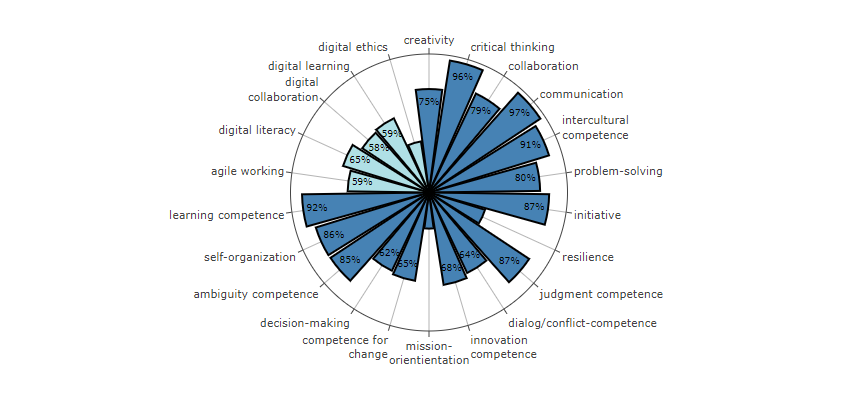
Whether problem-solving skills, initiative, or digital collaboration: so-called future skills are among the competencies that are becoming increasingly important for participation in the labour market and society. For the first time, a DatenCHECK by the CHE now offers a unique overview of how differently future skills are promoted in 30 subjects or subject groups across Germany, for example in relation to collaboration. The subjects of computer science, nursing science, and romance studies are particularly advanced overall.
Some fundamental future skills already well established in all subjects
In all 30 subjects examined, the majority of professors state that they promote critical thinking and problem-solving skills “strongly” or “very strongly.” Depending on the subject, the proportion ranges from 78 to 99 percent for critical thinking and 71 to 99 percent for problem-solving skills. According to the professors, judgment skills, initiative, self-organization, and learning skills are also frequently addressed in teaching in all subjects examined. The future skills profiles are particularly comprehensive in the subjects of computer science, nursing science, and romance studies: in these subjects, most of the professors state that they specifically promote a wide range of both non-digital and digital future skills.
‘Our data show that single fundamental future skills already play an important role in university teaching,’ concludes Nina Horstmann, expert on future skills at CHE and author of the analysis.
Significant differences between subjects in many future skills
Despite this overall high prevalence of certain skills, the picture for many other future skills is highly heterogeneous. For example, collaboration is particularly encouraged by 89 percent of professors in nursing science. In law, on the other hand, the figure is only 18 percent. Dialogue and conflict management skills are particularly important in social work, while innovation skills are promoted comparatively frequently in most engineering subjects.
‘The different subject profiles indicate that the promotion of future skills is oriented towards the requirements of typical occupational fields,’ Horstmann continues. ‘This is a key insight for curriculum development in order to discuss the prioritisation of future skills in a subject-specific manner.’
Digital skills less frequently promoted – but here also differences between subjects
There is still a clear need for development, particularly in digital skills. From the professors’ point of view, these are promoted less frequently overall than some non-digital future skills, but there are also differences between subjects. Computer science clearly leads the way in the overview of the five digital skills examined (digital literacy, digital collaboration, digital learning, digital ethics, agile working). However, digital skills are also already playing a greater role in business informatics, physics, nursing science and romance studies.
About the study
The results are based on three survey waves conducted as part of the CHE University Rankings 2023, 2024 and 2025. A total of around 9,000 professors of law, economics, mathematics, natural sciences, medicine, engineering and humanities at German universities, universities of applied sciences/technical colleges and dual universities were surveyed online. The survey examined the promotion of a total of 22 non-digital and digital future skills in 30 subjects or subject groups. The surveys took place between December 2022 and January 2025.
The author of the DatenCHECK report ‘Future Skills in Higher Education Teaching: Implementation Status in a Subject Comparison’ (“Future Skills in der Hochschullehre: Umsetzungsstand im Fächervergleich”) is Nina Horstmann.